



Data Engineer · Data Scientist · Policy Researcher · Michigan State University

Lowell Monis

Incoming Data Engineering Intern · Tesla, Inc.

Writing narratives and deriving change through complete and accessible data solutions.

Open to 2027 new graduate roles in data science, data engineering, and machine learning.

Lowell Monis

I build end-to-end data solutions, from engineering reliable pipelines to communicating findings that drive decisions. My work spans statistical modeling, machine learning, and policy analysis, and I bring deep fluency across the full data lifecycle. I am an ardent believer in communicable data science: storytelling is the most important part of the lifecycle (even the actual model), and I am committed to making my work accessible and actionable for all audiences.

Python R SQL Shell Scripting C++ MATLAB HTML/CSS/JavaScript Git & Version Control TeX/LaTeX ETL Pipeline Engineering NoSQL Databases Amazon Web Services Google Cloud Environment Management Reproducible Workflows Bayesian Statistical Modeling Machine Learning Time Series Analysis Natural Language Processing NLTK Experiment Design Data Visualization Data Storytelling and Communication Tableau Power BI Streamlit Plotly Dash R Shiny Microsoft Office Suite (Excel, PowerPoint, Word) Data Ethics and Privacy Responsible AI Practices Epidemiology Public Health Research Public Policy Analysis Political Text Analysis Graph Theory and Network Analysis End-to-end Project Management
Apr 2026

Awarded the inaugural CMSE Academic Achievement Award for outstanding academic achievement and contributions to the department.

Apr 2025

Won a first place award for my poster presentation on the policy and political impact of demographic diversity in U.S. state legislatures at the 2026 MSU Undergraduate Research and Arts Forum.

Mar 2026

Incoming Data Engineering Intern at Tesla, starting May 2026.

Dec 2025

Commencing research at JimLab investigating drug use epidemiology with Bayesian hierarchical models.

LinkedIn Activity
Follow on LinkedIn
August 2023 - May 2027 Current

B.S. Data Science

Michigan State University

Pursuing a Bachelor of Science in Data Science in the Honors College. Focused on incorporating rigorous statistical methods and computational tools to address real-world problems in public health and policy to maximize social impact. Student in the Department of Computational Mathematics, Science, and Engineering (CMSE) in the College of Natural Science.

Jan 2024 - Present Current

Research Assistant

JimLab, MSU Dept. of Epidemiology & Biostatistics

Developing Bayesian hierarchical models to study drug purchase opportunities and drug use incidence under Dr. Jim Anthony.

Aug 2024 - Present Current

Supervisor & Learning Assistant

Michigan State University

Supervising a team of tutors at the Mathematics Learning Center and serving as a learning assistant for multiple courses across departments. Courses include: Introduction to Data Science and R, College Algebra, Quantitative Literacy, Asian Politics, and Data Analysis and Visualization for Politics.

Jun - Nov 2025

Data Science Intern

Delta Dental of Michigan

Engineered ETL pipelines for Medicaid claims data and built patient treatment progression pipelines. Conducted MCMC and cohort analysis to inform business decisions and identify opportunities for improved care delivery. Predicted provider churn using XGBoost and LightGBM models and communicated findings via weekly standups.

May 2026 Incoming

Data Engineering Intern

Tesla, Inc. (Passive Safety Team, Crash Labs)

Incoming internship role. Details forthcoming.

NYC 311 Service Request Analysis
01

NYC 311 Service Request Analysis

Ingested and queried 200,000 NYC 311 complaints on AWS (S3 + Athena) to identify borough-level resolution inequities across city agencies, and built a logistic regression classifier, validated against SageMaker Linear Learner, to flag at-intake whether a request will resolve within 3 days. Icon: By Gwgross - Own work, Public Domain, https://commons.wikimedia.org/w/index.php?curid=165081658

AWS S3AWS AthenaAWS SageMaker AISQLPythonpandasscikit-learnJupyter Notebooks
More details

Problem

The NYC Mayor's Office of Operations suspected that certain agencies were disproportionately slow at resolving high-priority complaints in specific boroughs, a potential equity problem in city service delivery. They needed a data-driven way to identify which agency-borough combinations were lagging behind citywide benchmarks, and whether complaint metadata alone could predict resolution speed at intake, enabling earlier triage of slow-resolution requests before they age past service thresholds.

Approach

A random sample of 200,000 Q1 2026 NYC 311 service requests (Jan 29 to Mar 21) was loaded into S3 and queried via AWS Athena. SQL queries joined the complaints table to an agency lookup, computed per-agency citywide average resolution times as benchmarks, and surfaced agency-borough combinations where mean resolution time exceeded that benchmark. For the classification task, 173,870 records were extracted via Athena using a dedicated modeling query. Features included agency, borough, problem category, day of week, and hour of day. Zip code was dropped due to 1,768 missing values and the impracticality of one-hot encoding 200+ unique codes. An 80/20 stratified train-test split was used to address the 84-16 class imbalance between fast and slow resolutions. A logistic regression baseline was trained locally with scikit-learn and replicated on SageMaker AI using the Linear Learner built-in algorithm to compare local vs. cloud performance.

Results & Impact

The Athena stakeholder query surfaced specific agency-borough pairs with resolution times materially above their citywide agency averages, providing the Mayor's Office with an actionable ranked list for operational review. The logistic regression classifier achieved 84.7% accuracy and 98.8% recall for fast resolutions, with agency assignment (particularly NYPD) and hour of day emerging as the strongest predictors. The SageMaker Linear Learner reproduced identical results, confirming that cloud-based training offers no accuracy gain at this data scale, though the architecture is in place to scale to more computationally expensive models like XGBoost. A key limitation is the class-imbalance-driven bias: the model achieves only 10% recall on slow resolutions, underperforming on the exact cases most actionable for stakeholders. Addressing this imbalance via resampling or threshold adjustment is the primary next step.
The Dynamics Behind Exchange Rates
02

The Dynamics Behind Exchange Rates

Analyzed 25 years of daily Euro exchange rate data across 15 currencies to uncover macroeconomic patterns — from the 2008 financial crisis to the Turkish lira collapse — and built a SARIMA model to forecast the EUR/USD rate to within 0.7% of the actual value.

PythonpandasNumPystatsmodelspmdarimaSciPyPlotlyseabornJupyter Notebooks
More details

Problem

Exchange rate forecasting is a high-stakes problem for policymakers, investors, and multinational businesses alike. Despite extensive prior research, accurately predicting currency fluctuations remains difficult due to the non-stationary, seasonal, and event-driven nature of the data. This project investigates the EUR/USD rate specifically, asking: how many US dollars can you sell a Euro for on April 15, 2024 — and can a time series model get us close?

Approach

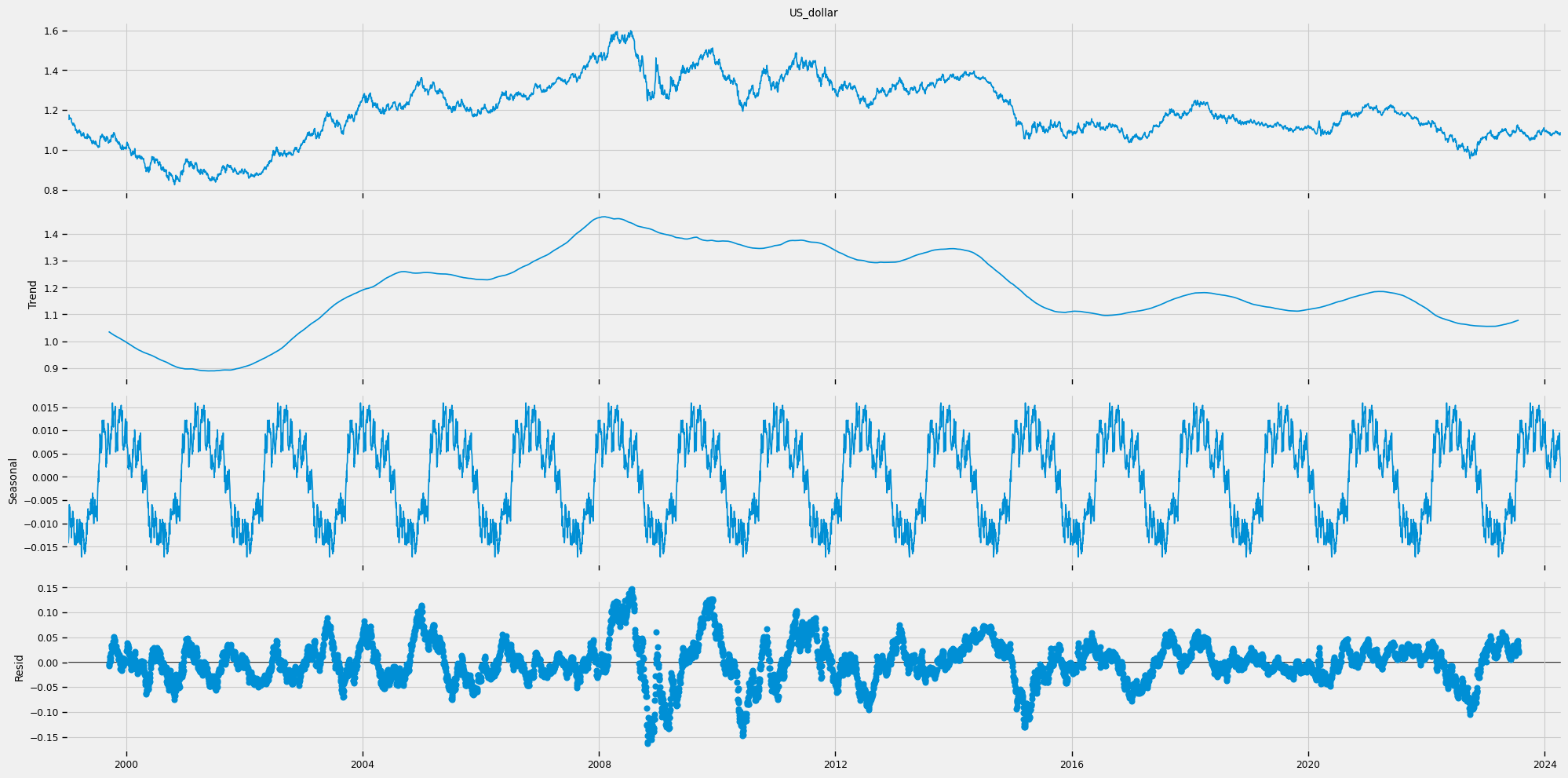
Using a dataset of 6,500+ daily ECB exchange rates spanning 1999–2024 (Kaggle, CC0), 15 economically significant currencies were selected for analysis. After cleaning column names, handling non-stationary values via differencing, and confirming stationarity with the Augmented Dickey-Fuller test, seasonal decomposition confirmed strong periodicity in the EUR/USD series. ACF and PACF analysis guided SARIMA parameter selection via auto_arima(), and a SARIMAX(0,1,0)(0,1,0,52) model was fitted and used to forecast 100 days ahead. Linear regression and residual analysis were also applied across all 15 currencies to characterize their trend structures and identify outliers.

Results & Impact

The SARIMA model predicted the April 15, 2024 EUR/USD rate at 1.0741 — within 0.7% of the Wall Street Journal's reported range of 1.0622–1.0667. The analysis also surfaced interpretable macroeconomic signals: the EUR/USD peak around 2008 aligned precisely with the global financial crisis, and the sharp inflection in the Turkish lira series pinpointed the onset of Turkey's 2018 economic crisis. Correlation analysis revealed trade-aligned currency pairs (e.g., Indonesian rupiah and South African rand) consistent with known bilateral relationships.

TikTok Integrity & Influence: A Misinformation Dashboard
03

TikTok Integrity & Influence: A Misinformation Dashboard

Analyzed metadata from 19,000+ TikTok videos to map how misinformation spreads through the platform's content moderation pipeline. Built an interactive Dash dashboard visualizing content verification flows and the relationship between video duration and integrity outcomes.

PythonPlotly DashpandasscipyJupyter NotebooksKaggle APICSSuv
More details

Problem

Mis- and disinformation on short-form video platforms is difficult to study because content moves fast and verification is inconsistent. This project examines how TikTok's moderation pipeline distinguishes "claims" from "opinions" and whether video metadata, specifically duration, correlates with integrity outcomes, aiming to surface structural patterns in how malcontent spreads.

Approach

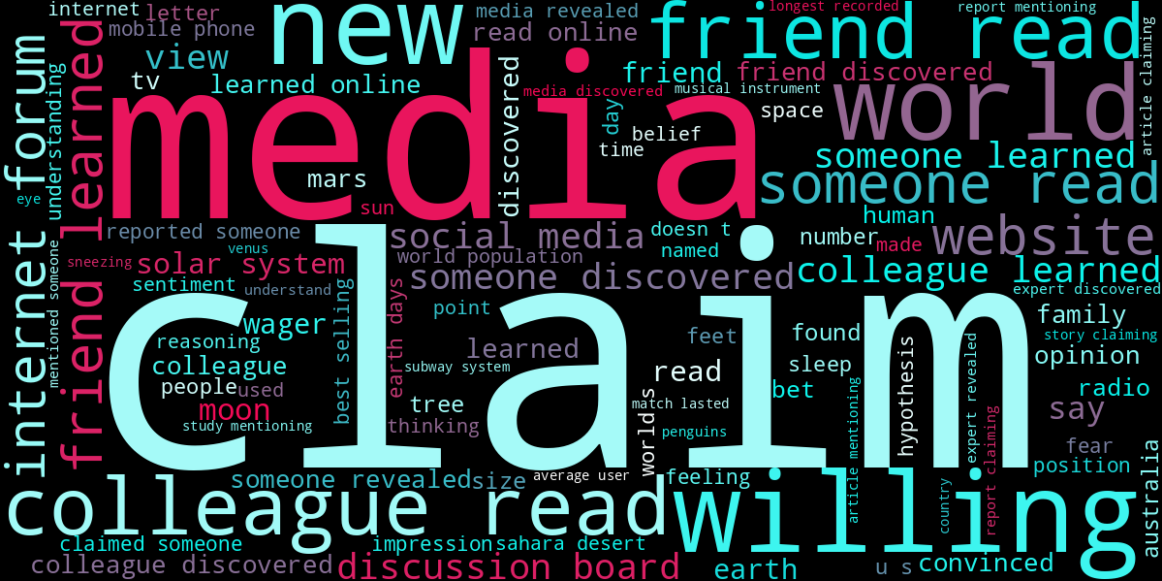
Using a pedagogical dataset of 19,000+ TikTok videos from Kaggle, features including claim status, verification outcomes, moderator review labels, and video duration were analyzed. A Sankey diagram maps the full content journey through the moderation pipeline, while kernel density estimation compares duration distributions across content types. The multi-page Dash app integrates a word cloud, correlation views, and interactive filters for exploratory analysis that is up to the interpretation of the viewer.

Results & Impact

Claim-based videos are disproportionately shorter and less frequently verified, creating a high-velocity environment where misinformation can thrive before moderation catches up. The final product is a deployed dashboard, titled "Algorithmic Accountability: Can TikTok Hold the Leash on Mis/disinformation?" that provides an accessible, interactive lens for researchers and educators to explore these dynamics without requiring local setup. The user has full control to explore the data and draw their own conclusions about the dynamics of misinformation on the platform, although a baseline is provided. A storytelling narrative is intentionally avoided to encourage critical thinking and personal interpretation. This is primarily a data exploration and visualization project rather than a traditional predictive modeling case study.

Lowell Monis

I am a data scientist and engineer trained at Michigan State University with a passion for leveraging statistical learning to address complex public policy and public health challenges. My experience ranges from engineering ETL pipelines for Medicaid claims at Delta Dental to developing Bayesian hierarchical models in epidemiology. I have a proven track record of building end-to-end machine learning solutions leveraging Python and R while maintaining clean systems for package management and data extraction via Git, SQL, and NoSQL tools, and I am particularly seeking roles where I can apply my background in data engineering and predictive modeling to drive actionable business insights and social impact.

I am currently a Researcher with the JimLab led by Dr. Jim Anthony at the Department of Epidemiology and Biostatistics at the MSU College of Human Medicine. I will be starting an internship with the Passive Safety Team in the Fremont Crash Lab at Tesla, Inc. in May 2026.

The Needle Drops

That's Life

Frank Sinatra

Frank Sinatra · That's Life · 1966

Click the record or the button to play — or just watch it spin. This turntable is an interactive fidget. So is the particle network in the background — particles.js by Vincent Garreau. Short attention spans welcome.

Current Order

Iced americano + 2 pumps of honey blend syrup + brown sugar cold foam

Bookshelf

Hobbies & Interests

Reading Photography Running Nature walks Hikes Numismatics Philately

Outside of my work, I'm usually soundtracking my life with a mix of sitcom marathons and curated playlists. I find that the right playlist is as essential to a productive coding session as a clean environment. There's almost always music playing in the background when I work. Currently, my music taste is dipping into reggaeton and old classics, but I'm always on the lookout for new recommendations.

Campus Leadership

SpartaHack

Co-Director

After serving as the Logistics Lead for a year, where we reduced operational costs by 40% while improving service quality, I now lead MSU's annual hackathon and one of Michigan's largest student-run hackathons.

Learn More

International Students Association

President

I have served as an Events and Outreach Director, Vice President, and now President of MSU's hub for international students, and its launchpad for advocacy, cultural exchange, community engagement and support. In my roles, I have worked with university leadership, advocacy organizations, and student governance bodies, while expanding ISA's coalition of affiliates, to advocate for the needs of international students and foster a welcoming campus environment.

Learn More

MSU Residential & Hospitality Services

Resident Assistant

I support students and foster community in MSU's residential housing by running effective programs, resolving conflicts, and creating a supportive and safe environment for 50 residents, while serving in an on-call capacity to manage crises, run emergency response operations, enforce policies, maintain safety.

Learn More

MSU Undergraduate Research Office

Research Ambassador

I promote undergraduate research engagement at MSU, assisting students find and thrive in research opportunities, while supporting office programming.

Learn More